Bring your film.
Copy a supported HEVC MP4 file to a USB drive. Insert it into the player. Your film stays with the screen.
BUILT FOR EXHIBITIONS
A 4K media player for artists, galleries and exhibitions. Add your film on USB, connect HDMI and power on.
No computer. No login. No internet required for local playback.
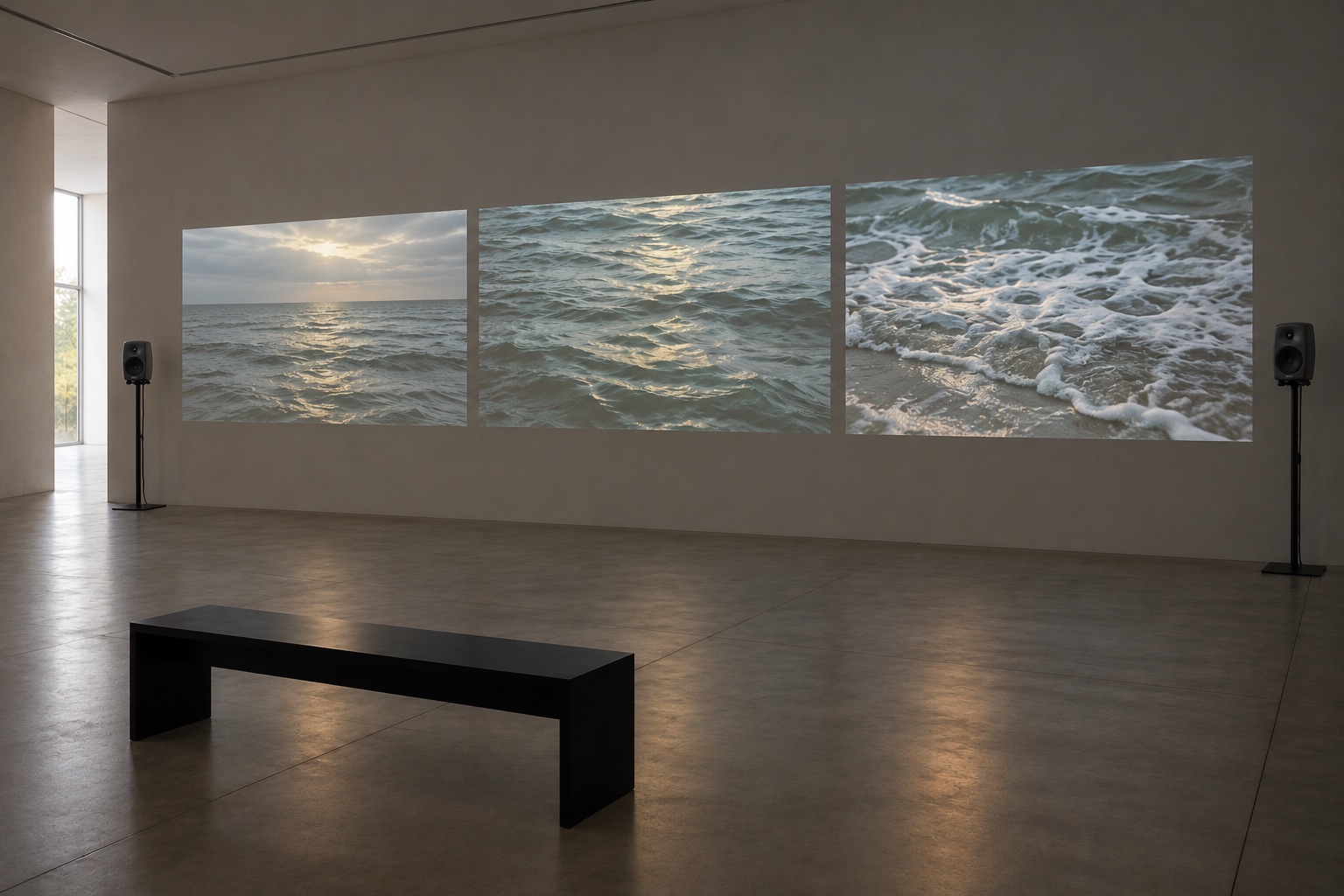
Three-channel projection + stereo sound · AI-generated gallery concept
PLUG&PLAYER STANDARD · 4K MEDIA PLAYER
Provisional prototypeA compact player being developed for local 4K exhibition playback, with a proposed 3.5 mm stereo line output for your sound system.
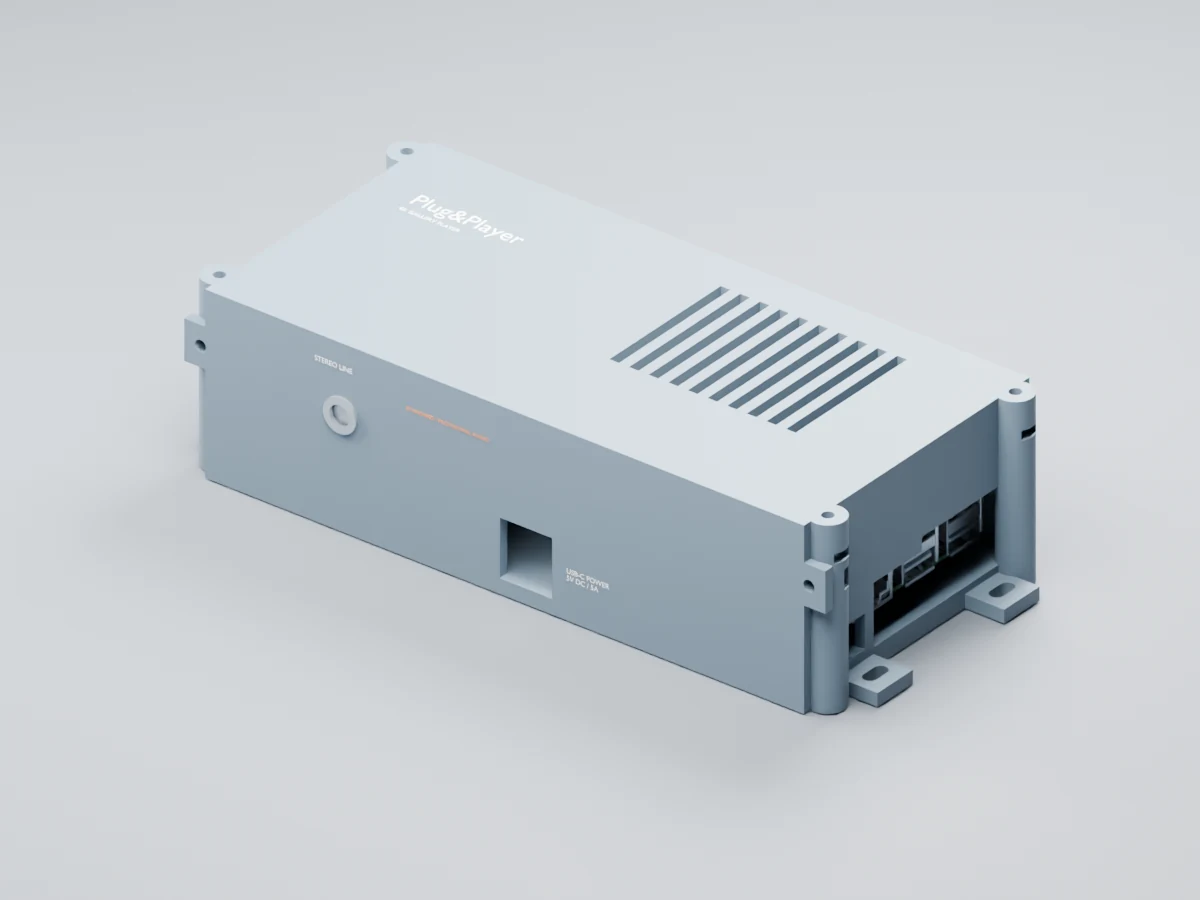
Drag to rotate · Pinch or scroll to zoom. Reset restores the assembled view. With reduced motion, use the still assembled and exploded views.
Static render shown. Interactive model is optional.
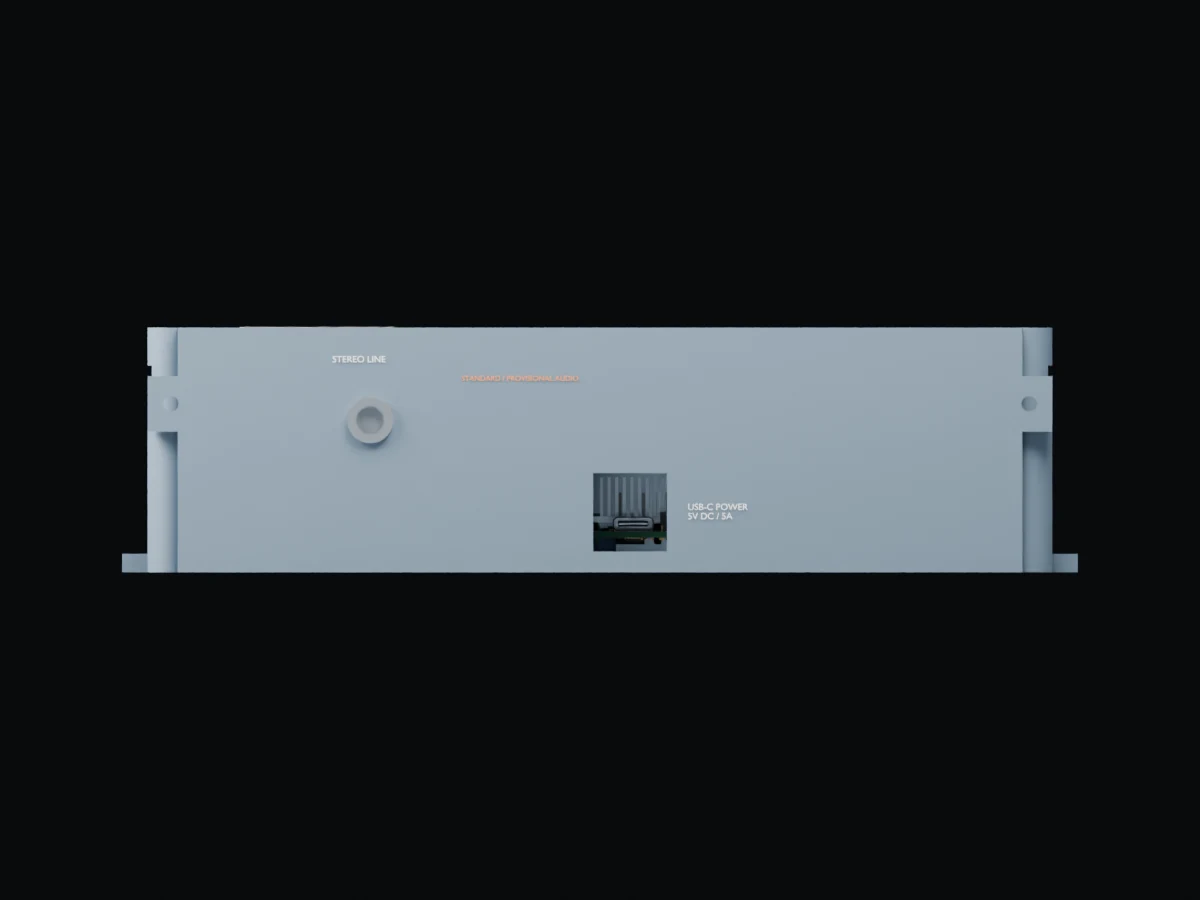
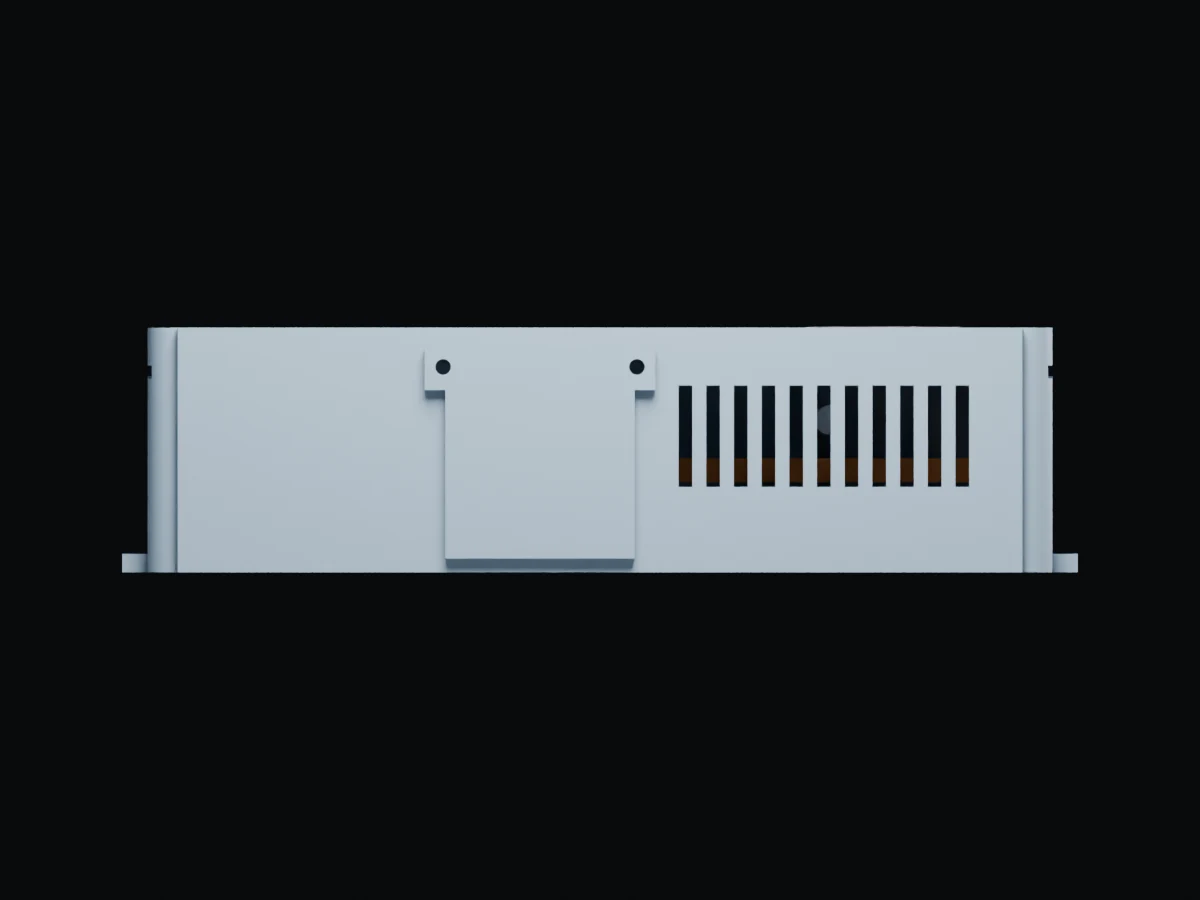
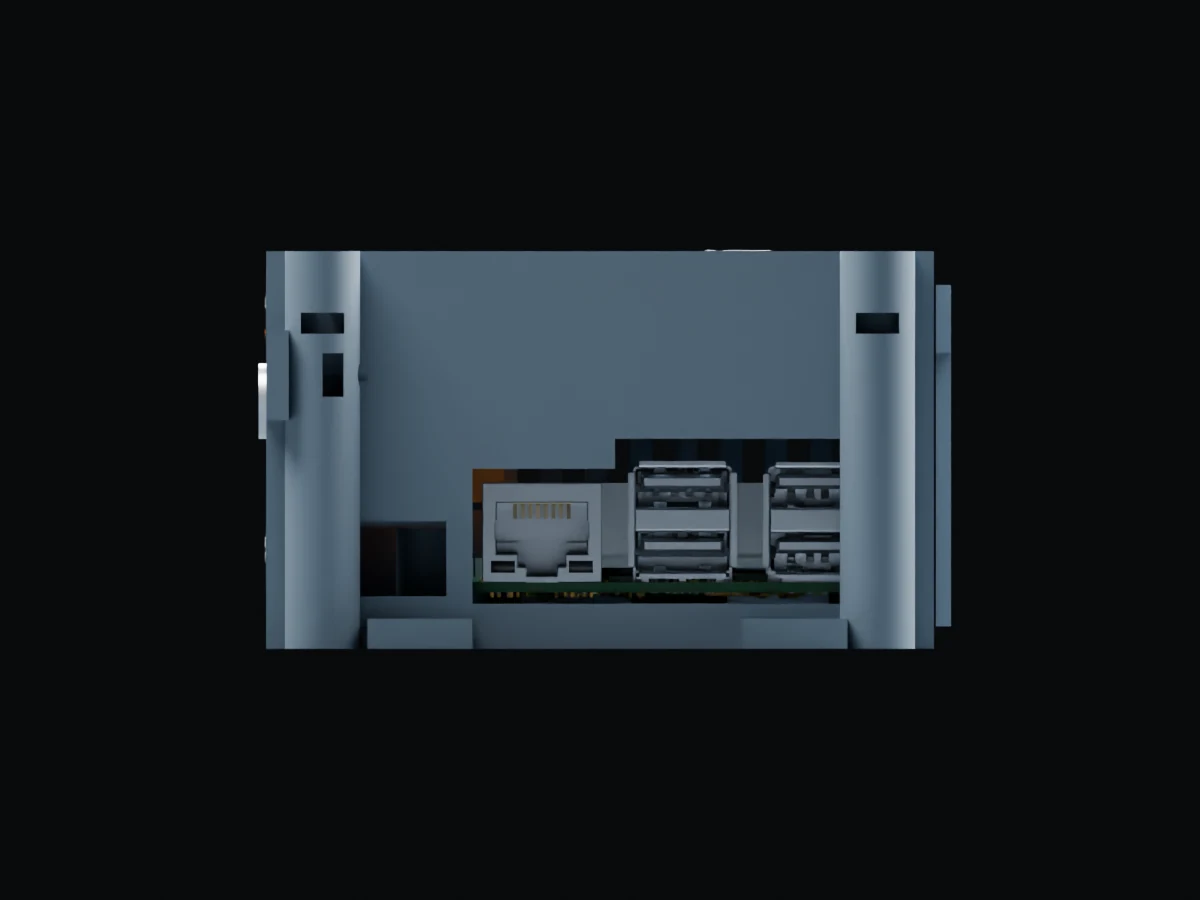
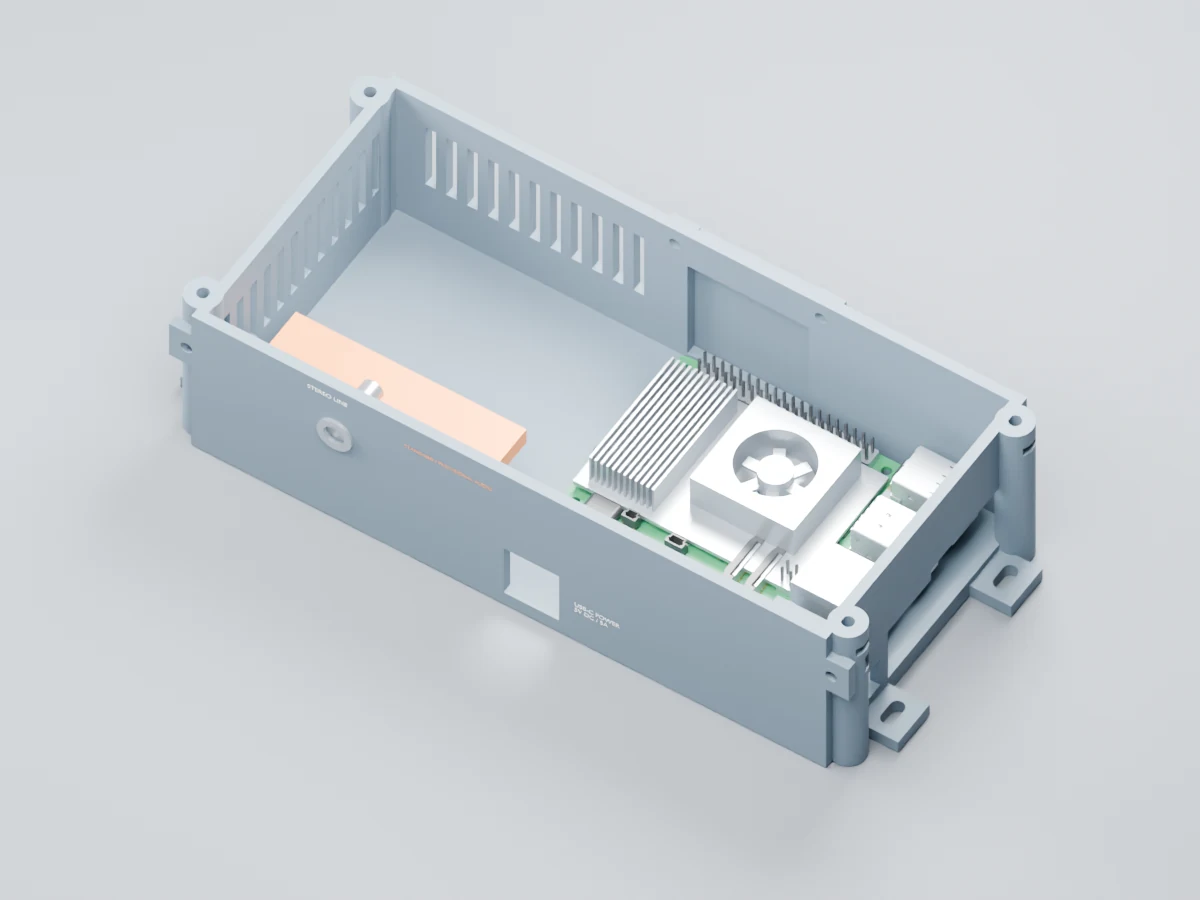
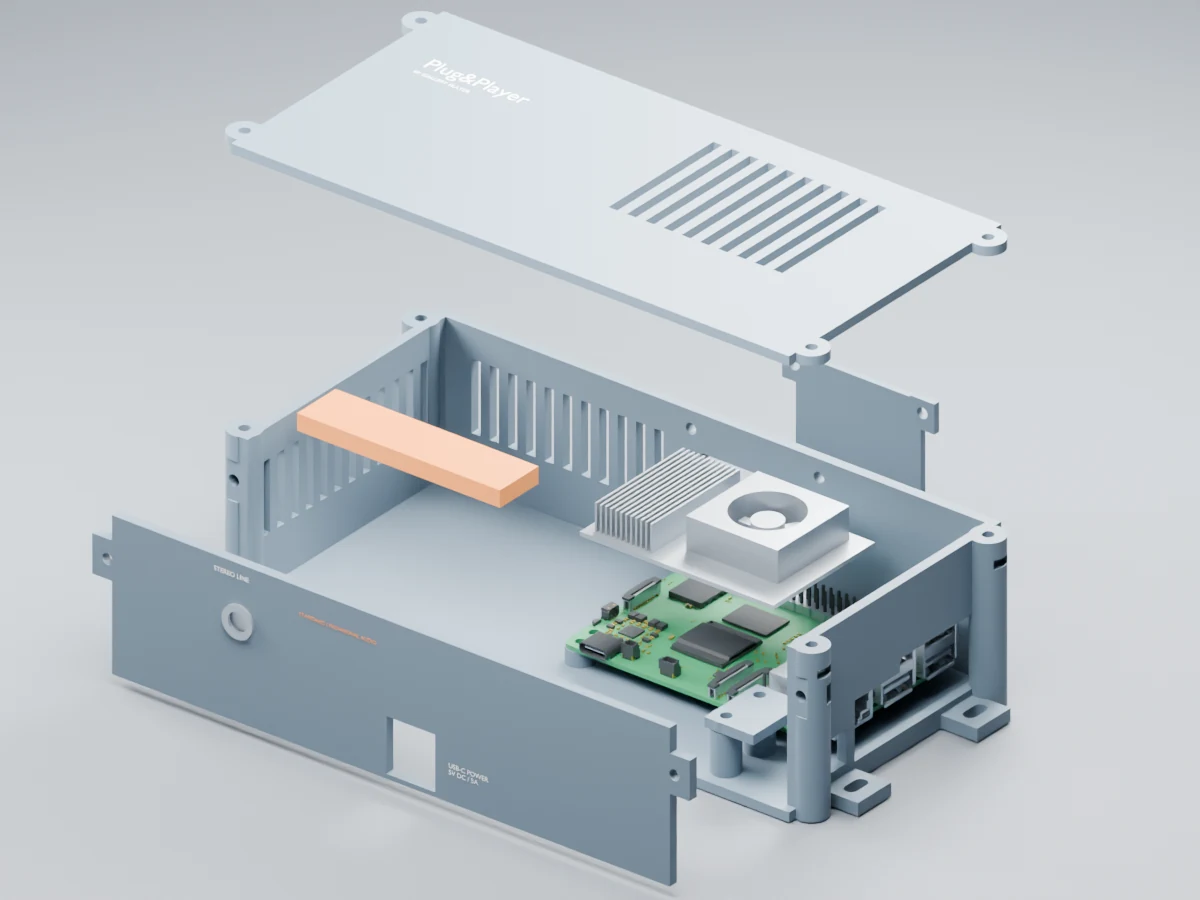
These renders and the animation show a digital prototype. They are not proof of physical fit, cooling, electrical operation or playback performance. Audio mounting details remain unverified; physical testing is still required.
PRO XLR · STEREO LINE OUTPUTS
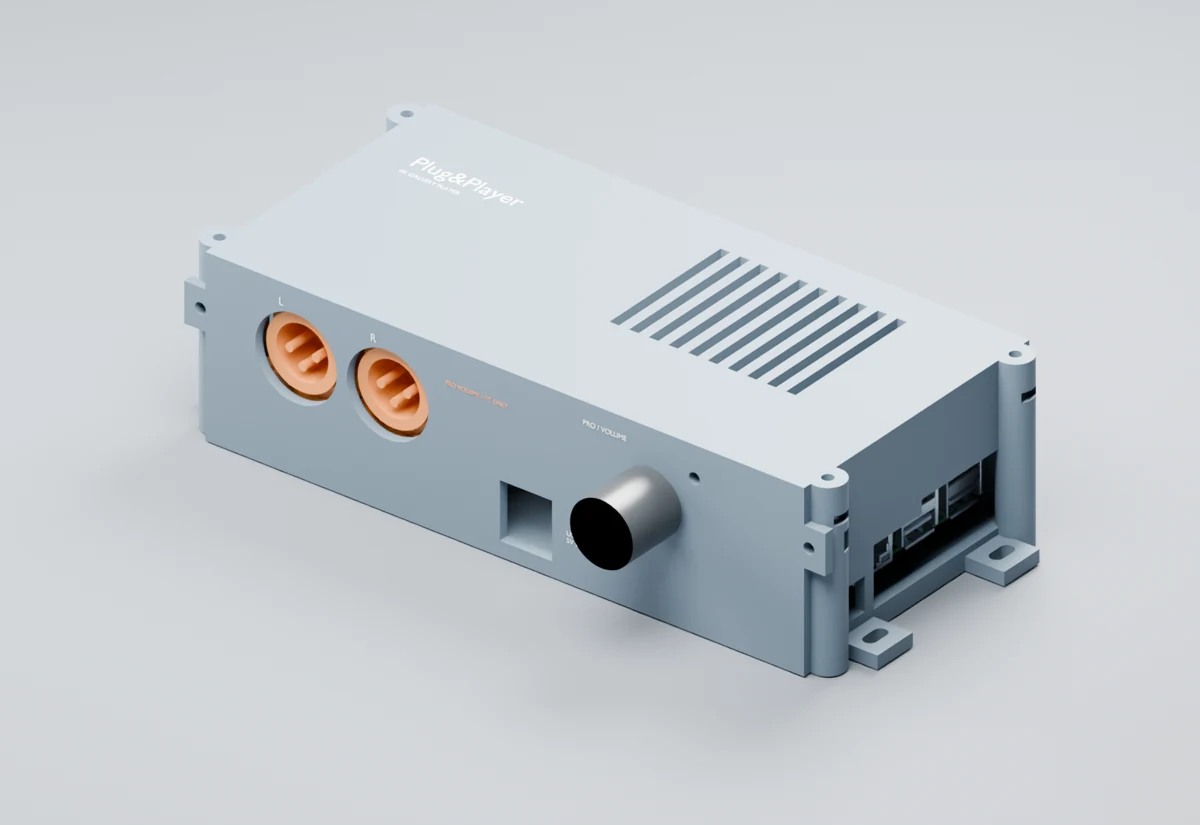
Balanced stereo XLR line outputs for mixers, powered speakers and installed exhibition sound systems. The Pro-only front volume knob is designed to adjust both channels together.
PRO XLR · WORK IN PROGRESS
Taking the enclosure from a digital model to a physical fit test.
Plug&Player Pro is being developed around a Raspberry Pi 5 with active cooling, balanced stereo XLR audio and a physical volume knob for exhibition sound systems. Standard keeps its separate 3.5 mm audio design without this knob.
The latest Pro fit prototype adds a removable encoder carrier, rear keeper and space for a disconnectable wiring harness. The knob position was chosen using modelled XLR-plug, power-plug and finger-space allowances. Existing ports, mounting ears, ventilation and fixings are retained.
Saved CAD, solid/mesh checks and sampled collision checks passed locally. Actual plug comfort, turning and pressing loads, and physical fit still need testing; dimensions may change.
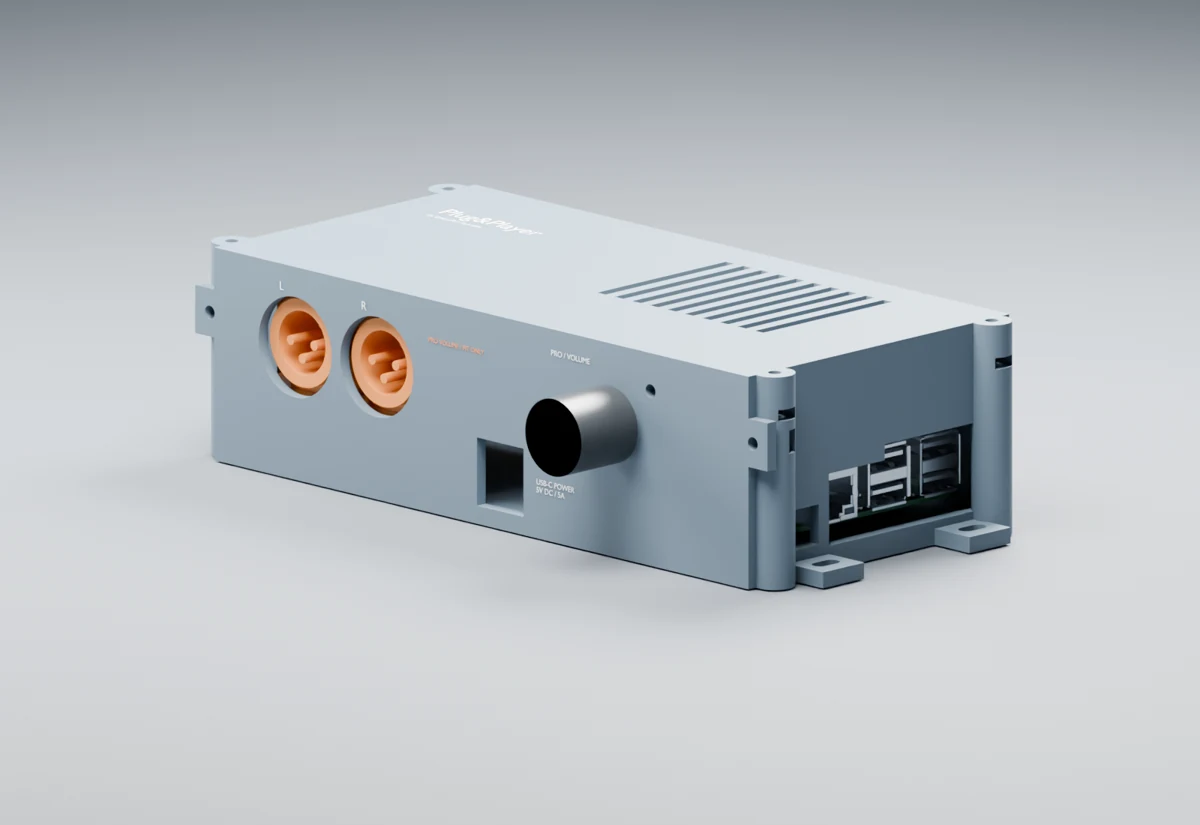
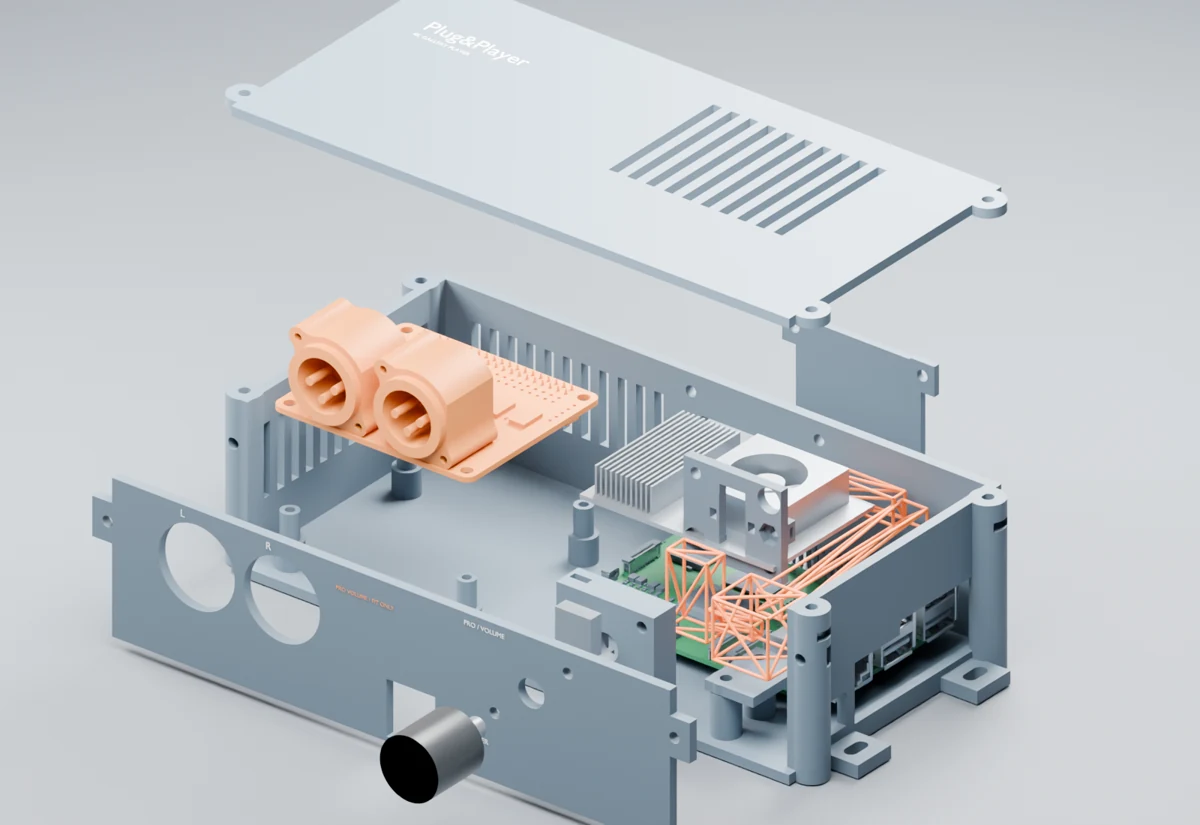
Orange audio geometry is the older DAC reference, not verified DAC2 Pro XLR fit. Orange wire outlines reserve space for soldering, a disconnect and routing; they are not selected or connected hardware. These are digital visualisations, not photographs of a tested product.
CONNECTION TO VERIFY
The proposed side-by-side DAC connection remains untested and unsupported by the board manufacturer. Its occupied GPIO header needs a checked breakout or pass-through for the encoder. Harness hardware and GPIO assignments are provisional; no working electrical connection is claimed.
NEXT DEVELOPMENT STAGE
Next come actual-part measurements and a small encoder-mount fit coupon, followed by load and cable-access checks. Stereo volume, optional press-to-mute, balanced audio, playback and closed-lid cooling require separate software and bench tests. None has been performed.
THE EVERYDAY ROUTINE
The V1 workflow: connect HDMI, insert your USB drive and power on. Your film starts automatically and repeats while powered. Automatic start and seamless looping remain targets to validate on hardware.
Copy a supported HEVC MP4 file to a USB drive. Insert it into the player. Your film stays with the screen.
Connect HDMI to your display and plug in the supplied power adapter. Power on: the intended default is automatic playback.
Your film repeats from USB storage. No keyboard, remote or computer needed. Phone setup is there when you need to change settings.
We’re building for a repeatable daily opening: playback resumes after power returns, a watchdog restarts stalled software, and standalone loops continue if the network drops.
Recovery and uninterrupted playback are engineering targets. They must pass sustained hardware and exhibition tests before sale.
MULTIPLE SCREENS? SYNC THEM.
One player per screen, with a film stored on each USB drive. Wi-Fi or Ethernet coordinates playback. You are not streaming several 4K films over the network.
Wi-Fi sync is a development target for installations that tolerate small timing differences. Ethernet is the preferred route for adjacent screens and repeatable timing tests.
Sync accuracy is not yet measured. Neither route is currently offered as genlocked or frame-accurate.
Build a multi-screen briefIllustrative artwork stills · AI-generated
PHONE CONTROL · INTERACTIVE CONCEPT
The proposed phone controls bring your selected screens into one group. Try starting, pausing, restarting or stopping the group, then see what happens when a player goes offline.
This is an interactive concept with simulated feedback. No players are connected, no playback commands are sent, and sync accuracy remains unverified. Setup is not implemented.
PROVISIONAL UK DIRECT PRICING
Plug&Player is a finished-appliance concept for galleries, artists, museums and exhibition installers. Prices below are draft UK direct-sale figures and assume VAT registration. Confirm VAT treatment, enclosure, accessories, warranty and shipping before publication.
HDMI AUDIO
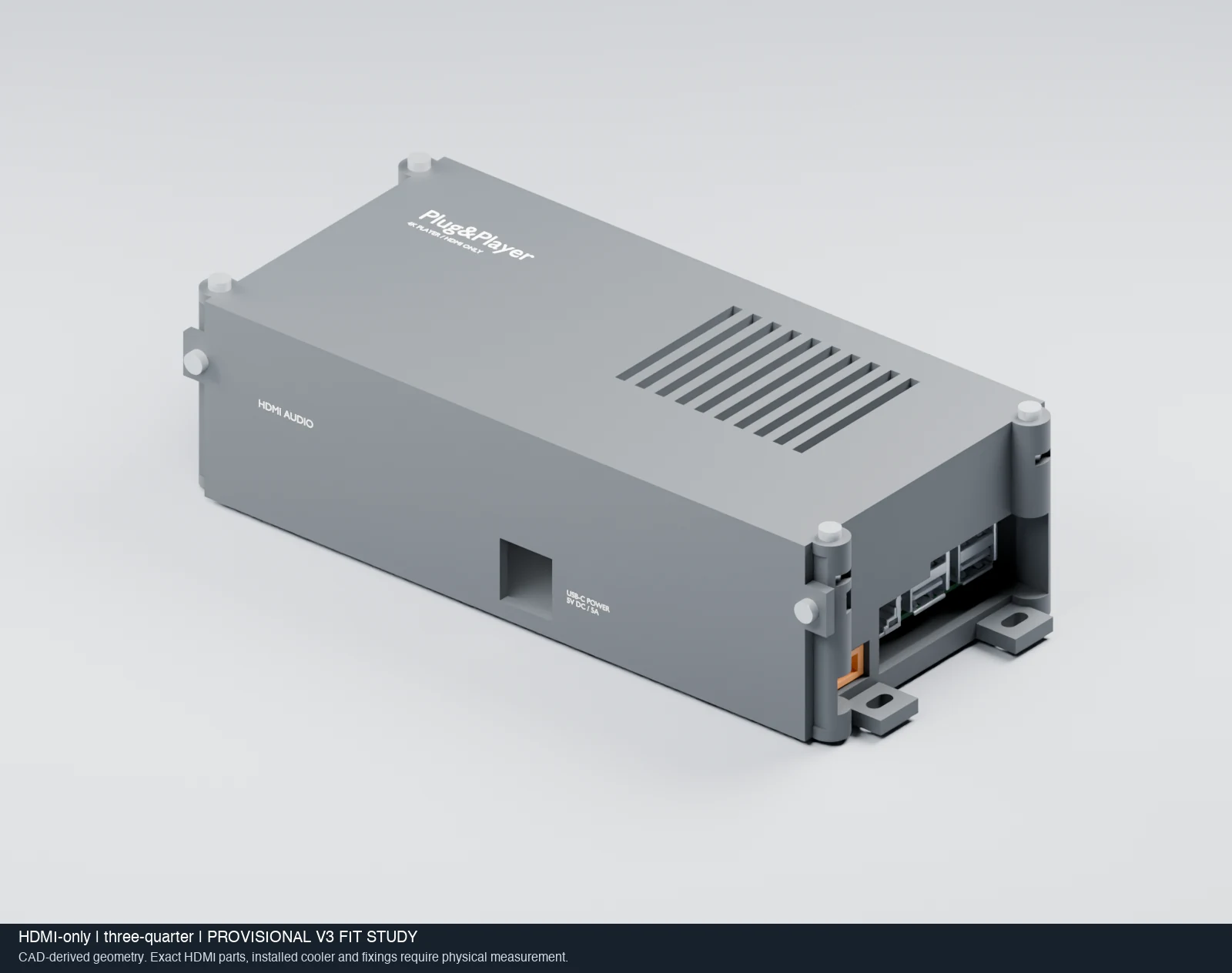
£349
including VAT · £290.83 excluding VAT
One display, with sound through the display or an HDMI-connected receiver.
STEREO LINE · +£50
£399
including VAT · £332.50 excluding VAT
A proposed 3.5 mm stereo line output for nearby powered speakers or an amplifier.
BALANCED STEREO · +£200 VS STANDARD
£599
including VAT · £499.17 excluding VAT
Balanced stereo line outputs and a Pro-only physical volume knob for a mixer or installed sound system.
| Feature | HDMI-only | Standard 3.5 mm | Pro XLR |
|---|---|---|---|
| UK direct price | £349 inc VAT £290.83 ex VAT | £399 inc VAT £332.50 ex VAT | £599 inc VAT £499.17 ex VAT |
| Video | Same proposed local 4K playback target across all three. Audio upgrades do not improve video quality. | ||
| Audio connection | HDMI audio to the display or receiver; no internal analogue output | Proposed 3.5 mm unbalanced stereo line output | Proposed balanced stereo XLR line outputs |
| Physical volume knob | Not included | Not included | Pro-only fit prototype; stereo volume and optional mute software untested |
| Best fit | Display or receiver already handles the sound | Nearby powered speakers or an amplifier | Mixer or installed sound system using balanced cables |
| Validation status | Provisional. Physical fit, output behaviour, playback, cooling, mounting and included accessories still need testing and confirmation. | ||
WHICH MODEL SHOULD I CHOOSE?
HDMI-only — £349: for a display or receiver that already handles sound. Standard — £399: for a simple stereo line connection to nearby powered speakers or an amplifier. Pro XLR — £599: for a professional sound system using balanced stereo cables, with a planned front volume knob.
The £50 Standard and £200 Pro XLR upgrades are provisional UK direct-sale price proposals. They change the audio connection; none of these players provides speaker amplification. Final audio routing and simultaneous HDMI/analogue output remain unverified.
No payment or reservation is taken. Prices, tax treatment, fulfilment, included accessories, warranty and shipping remain provisional. The proposed 3.5 mm and XLR outputs are stereo line outputs for powered speakers or an amplifier; they are not microphone inputs, headphone outputs or speaker amplification.
A CONSIDERED STARTING POINT
Raspberry Pi 5-class hardware, configured as a dedicated player. A simple export preset and a clear compatibility list matter more than a long list of untested formats.
Proposed end-product specification. The Pi’s hardware capabilities are not proof of finished-player performance.
FOR PEOPLE WHO SHOW WORK
One to eight screens, a USB film and a repeatable daily opening routine.
Clear status, documented exports and a spare-player plan.
Local content for focused displays without a full signage CMS.
FROM THE EXHIBITION FLOOR
Developed by Jim Brouwer, an AV consultant and creative technologist with more than 20 years of experience in gallery installation and production.
Jim’s work spans AV installation, video, sound and time-based media, including managing AV installations at Nottingham Contemporary.
That experience informs the player’s priorities: straightforward setup, clear status and a repeatable opening-day routine, so the people looking after an exhibition can focus on the work.
Meet Jim and explore his experienceThe player is in development. Jim’s professional experience informs the design; final playback and reliability tests are still to come.
BEFORE THE OPENING
No internet connection is required for the intended local playback workflow. Your film plays from USB. Wi-Fi is for optional setup and sync; network-loss recovery must be tested.
That is the target, not a verified claim. We must test decoded-frame continuity and audio transitions across repeated loops. Content also needs a properly authored beginning and end.
Planned, with files local to each player. No millisecond accuracy is published yet. For joined images or strict frame alignment, require a measured demonstration; Ethernet alone does not provide genlock.
V1 targets HEVC MP4, 4K SDR at 24, 25 or 30 fps. Presets and limits will be published after testing. ProRes, arbitrary 4K H.264, HDR and unusual frame rates are not promised.
The proposed kit includes the player, cooler, case, power supply, HDMI cable, OS card and 64GB media drive. You provide the display and film. Ethernet leads, switches and larger drives are additional.
The same player, plus proposed mounting accessories, a 30-minute remote commissioning session and priority support during published business hours. It is not a different codec or a frame-sync guarantee.
Proposed: a 2-year hardware warranty, weekday UK support and five years of security updates from the last sale of the model. Terms and staffing must be confirmed before launch. Statutory consumer rights remain additional.
No. This is a launch prototype. Hardware proof, regulatory assessment, final terms and a real order service are required before sales open. You can prepare an installation brief below.
MAKE ROOM FOR THE WORK
One screen or a whole exhibition: start with the number of players, the venue and the timing your work needs.
This prototype creates a downloadable brief on your device. It does not send an enquiry or store your details on a server. A real sales contact must be connected before public launch.